The Stuff that Makes our Family History
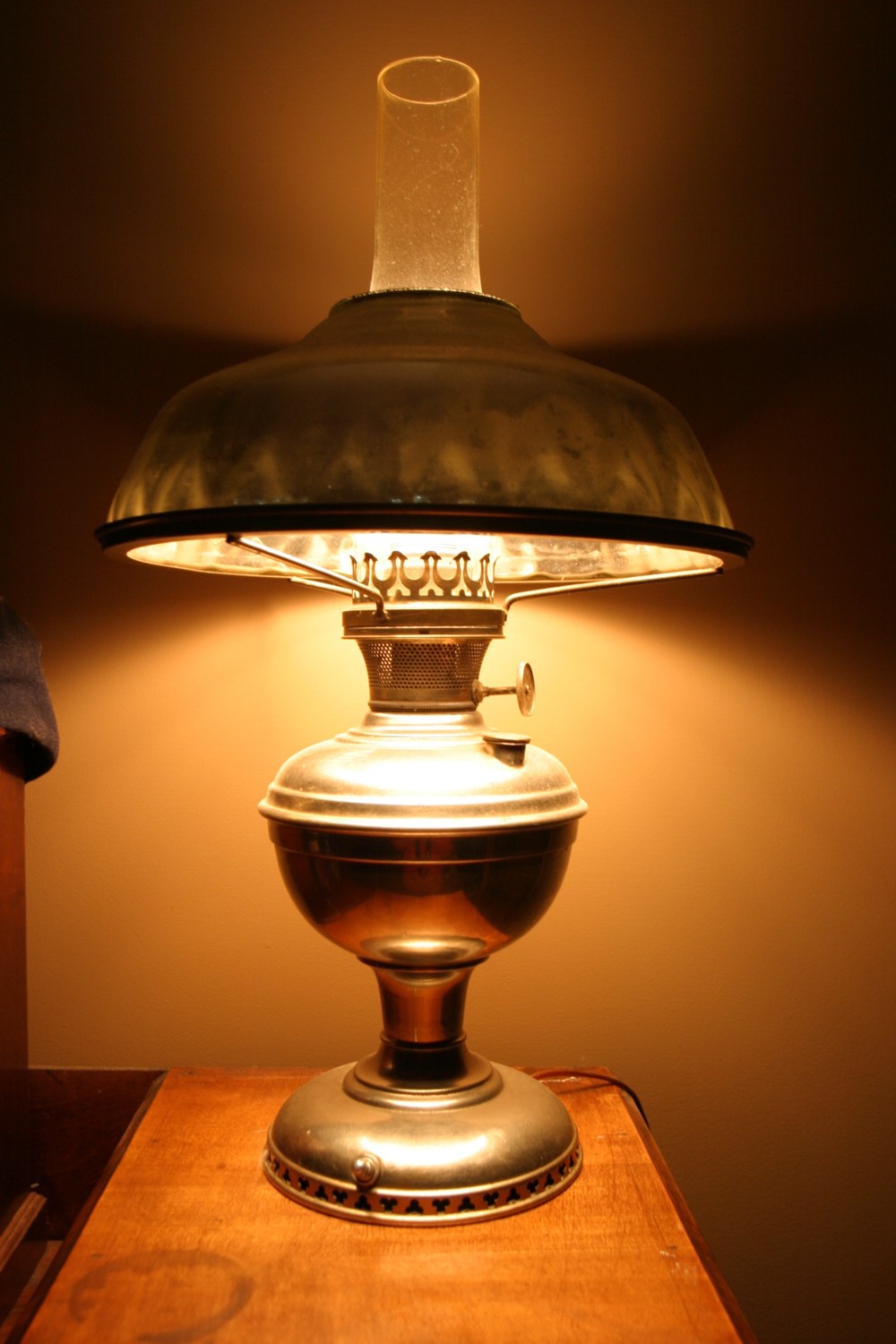
Oil to Electric Converted Lamp
When I wrote the post, “The Stages of Eliminating Stuff,” I wrote about letting go of the sentimentality of some of the stuff we had, which was my mother’s. She and my father used to antique quite a bit and I had some very large pieces.
Obviously, we don’t have room for a lot of big furniture. I knew what she loved most and I loved most of the same pieces and resolved to find a use and space for them.
One of our Living Large community, Martin, made some good points in a comment: “I have antiques from Great Aunts/Grandparents/parents who worked hard to buy them–they came (from) Ireland with nothing and from what you are working to go to as a life style. I would find it is disrespectful to dump these things-they are more than sentiment–they are family history. With that said-there are so many other things I realize I can and will part with, but not the family history!!”
His comment first made me doubt whether I should be eliminating any of these things from our lives and also wonder if there are different sets of rules for items considered to be family history, rather than just stuff, or even stuff with sentimentality attached.
I once again confronted my doubts as many of these antiques that were so prized by my mother are still sitting in our storage building. I know how hard my father worked and I was on many of the antique shopping adventures with them when some of those items were purchased. I also know how hard my mother worked to restore many of the pieces.
Believe me, I once wholeheartedly agreed with Martin. That’s why our 1,100 square foot house in the city was stuffed full of furniture and stuff my mother had already given us.
Maybe 10 years ago, I read a remarkable essay by a woman who had just lost her mother. Like mine, her mother collected antiques and had many prized possessions. This woman wrote the essay after storing her mother’s belongings for a year. She kept what she could and gave to her children what they wanted.
At the time, I wondered how anyone could part with something that belonged to their mother, but as I thought more about it and eventually had to clean out my own mother’s apartments twice, my outlook changed.
It’s not until you have to sort through 82 years of your parents’ lives in the stuff they leave behind that the reality hits you that in the end, you cannot take it with you and what you’re leaving is a lot of heart-wrenching work for the family you also leave behind.
There are things I will not ever part with such as that dry sink, her reading lamp, her china and a new find – the letters she wrote to my father while he was stationed in the Army during WWII. But I’ve come to the conclusion that I cannot keep it all simply because it was cherished by my mom or is a part of my childhood memories.
My nephews do not want these huge pieces and our daughters live out of the country.
In this thought process, I’ve come up with a few tips for parting with stuff that is a part of your family history:
- Assess its sentimental value to your family history: The first thing you must do is assess how important this item is to your family history. Did your great-great grandparents bring the item from their homeland? Is it a part of your family history’s story, which means it must be something more than someone’s baby blanket. It must be central to who your family is.
- A place for everything and everything in its place: If you haven’t built your small home yet, take these items into consideration. Where will they be placed? Can they take on multi-purpose use? When my aunt built her home down the road from us, she designed one wall in her kitchen to specifically fit an oddly shaped corner cabinet that was a family heirloom. Think about your design and uses.
- Giving it away: If you cannot use it and don’t want to store it, the best thing is to give the item to another family member who might appreciate it and its history. If no one in your family is interested, how about donating it to the local historical or cultural society? If the piece has a monetary value, find a reputable antiques appraiser and sell.
- Document: If you have to part with your beloved relative’s antiques, you can document them forever by taking photographs and placing them into a special memory album and/or recording it all on video. You can go back and revisit those items anytime!
Do you have a lot of items that are part of your family history? What would you never part with? If moving to a smaller space, how would you deal with it?





Having five siblings helps, as does living outside your country of origin, and having a small home too. I know the large antiques my beloved grandmother gave us have found homes better suited to them, while I still have lovely reminders of her (small ones) dotted through my own place.
Oh, that would be nice, Sarah, to have so many relatives to share things with and have each one take the things that are best suited for them.
This raises many deep questions. In the end, though, your parents aren’t around, so you can’t disrespect them or hurt their feelings. These items may have been cherished by them in their time and place, but I’m sure your parents never intended for you to be weighed down by their possessions. I know I would never want my daughter to hang onto something of mine that she didn’t really want just out of guilt. That serves no purpose. And by giving them away, you can bring light and happiness into someonne else’s life.
Exactly how I’m trying to look at it now, Alisa.
The hardest thing…I think for most people is that someone important to them has cherished an item. And it’s almost like letting go of some trinket is a betrayal.
I agree, Mat, and I know that feeling because I have felt it as well.
I actually don’t have any family heirlooms. But, if I did, I agree with some of the others that suggest donating them to a historical society.
How did you escape the family heirlooms, Jeanine?
I had to empty my folks house out last year – and my mother had meticulously saved sooooo many family heirlooms. It has taken me over a year to sort thru them all. I have tried to distribute out things that other family members might like to have as best I can. But I am an only child, and have no children of my own, so the “history” sort of ends here. The thing I have the hardest time with is all the photo albums full of pictures of people that nobody else is going to know when I’m gone.
At least you know them, Teresa. Do you have cousins maybe? I did not even know my grandparents, so I have photo albums full of people I cannot even put names to!
Oh my gosh, I have SO much of this stuff, and more coming because my mom is 88 this year. You’re right – it’s heartwrenching and emotional to deal with it all. I think maybe the really personal stuff – the letters, paintings and things like that should definitely be kept.
Good luck with that, Jane!
I’m the first — and so far only — one in my family to downsize. My parents and brother still hang onto every little thing, from elementary school papers and childhood toys to inherited stuff that doesn’t get used for whatever reason (ugly furniture, unappreciated art, photos of long-dead family members that no one can even identify, etc.)
Click on my name to see the article that really sums up how I was able let go of sentimental items.
At the end of the month I am moving to a 223-square-feet home and this is the final push to let go of even more.
I started downsizing two years ago and I can honestly say that I can count on one hand the number of things I regret giving away. And the regret is fleeting.
Wow, Claudia, great story and testement to just how little things really mean. Thanks for posting!
I have more and more tried to listen to my heart/gut, and not anyone else, when assessing what to keep and what not to. The best is what, like with your lamp, there is a way to utilize the piece, if not functionally, then because you just like looking at it.
That’s a good policy, Merr.
I’m wondering if any of these items might be donated to a local historical society? I know there are several in our area–one for each little town. It might be worth a phone call. I don’t consider myself very sentimental but I must say I just cherish some of my family’s heirlooms. Yes, they sit in a box in the basement someday I’ll figure out how to display them, but I enjoy having that…oh, connection.
Yes, I suggested donating to a historical society above. That is a great way to ensure your family’s heirlooms will be appreciated by thousands of people.
Sometimes I look at what I’ve kept — mementoes from my parents that would have no meaning to anyone else. I realize that I can’t bear to throw them out, but my children will someday.
And it will be a very difficult decision for them.
good ideas, Kerri.
from a bit of a different perspective — a friend of mine is a professional musician. she decided many years ago, when her son was small (he’s an adult now with children of his own) that she would make a box and put in it the things from her professional career that she’d like him to keep/have/know about after she’s gone.
it’s not a big box, especially considering all she’s done and all that’s been written about her, but it contains the photos, recordings, playbills, letters, ticket stubs, awards, and such that mean the most to her from that work, and of course she adds to it now and again. I imagine her son will make his own choices, too, when the time comes, but I liked the idea. what do you think?
I think it is a wonderful idea, Kerry! I have a little book my mother started writing her life story in. She only got about 50 pages of it done, but of all of the things she left, that is the one I love the most because it was intended for me.
I think anyone that has family heirlooms – especially personal correspondence – is so fortunate. I have a few things from my grandparents that I will not part with: a lamp, a small glass table, a painting. I love having them in my house; it feels like I have a piece of the person along with me.
It is that emotional connection of the memories that make it so hard for us to shed ourselves of these things, Sheryl. When I see that lamp pictured above, I still have a picture in my mind of me sticking my head into their bedroom after being out late and telling her I was home. She would read late into the night in bed with that lamp. My mom, reading, it is all a part of who I am.
These are good tips. I inherited a lot of items from my grandmother. Much of it is in storage right now. But I have plans to use it – for example when my kids move out, the bedroom set will become my spare bedroom. I also intend to give much of the china and glassware away to my children once they have their own homes. It was very hard to sort through her belongings and decide what to keep and I probably ended up taking more than I should have.
That’s a good plan for using the stuff when your kids are out of the house, Brette.
I do have way too many things that are part of family history. I am not personally attached to any of them but have gotten stuck with them because other family members “may” want them but not just now. I am about to start issuing ultimatums for them to either come and get them or they are gone. I seem to lack the gene that causes me to have a sentimental attachment to anything. It’s all just “stuff” and, as you say, we can’t take it with us when we pass on.
I suppose the one thing I would keep is my Mum’s recipe book – the one where all her handwritten recipes are. I like it mainly because it IS written in her own handwriting and some of the recipes remind me of my childhood although I rarely make any of them since being diagnosed celiac unless I can adapt them to gluten free. I doubt that my kids will ever want it because my mother had a very stylized handwriting and they complain that they can’t read it!
Oh, I would let those family members know that there’s no time like the present, Olivia! I wish I could develop your gene that detaches us. If you could bottle and sell it you would make a fortune with people in the small house movement! 🙂 Recipe books handed down from generations are also keepers. Unfortunately, all of my mother’s recipes were in her head. While I got most of them, not getting that one for pumpkin pie haunts me to this day.
Oh, I would find it very difficult to part with that kind of stuff, too, Alexandra. That might be one of those things you cannot ever part with. I have poems and stuff my mother wrote way back in high school. A great niece expressed an interest on FB the other day in reading some of this stuff. I think what I might do is copy those writings and the letters and bind it somehow for my nephews and great nieces/nephews and then leave the originals to her after I’m gone.
What sage advice! Getting rid of stuff is fraught with anxiety and you’ve provided some actionable steps.
Best, Irene
Thanks, Irene!
This is a great post for anyone facing this situation. Strangely enough what I have not been able to part with are my parents’ papers and especially book drafts. I know this is silly. I need to throw out the boxes of type-written pages. But they were composed before computers, and meant so much to the writer. Fortunately I have an attic where these boxes can sit for now, but, at some point, I must part with them. Perhaps, once I get my dad’s memoir out as an ebook??